
You will get the results you want if you focus on just one important thing instead of wasting time and energy on hundreds of insignificant things.
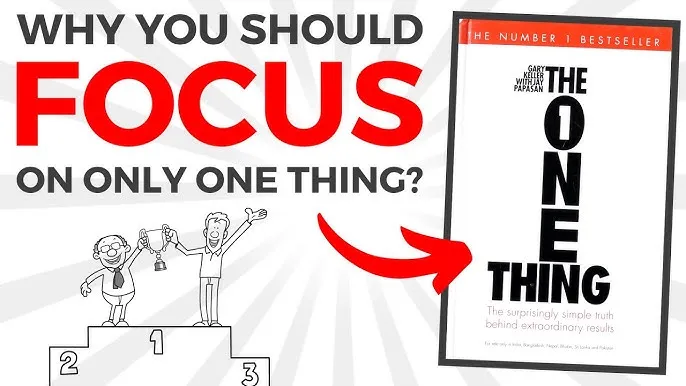
What is the principle of the main thing
This is the approach to achieving a goal, as described in Gary Keller’s book “The One Thing: The Surprisingly Simple Truth Behind Extraordinary Results”.
Whatever goal you set for yourself – big or small, Keller suggests that you start moving toward it with the question: “What is the one thing I can do now that will make everything else seem simple or unnecessary?”
Ask yourself this question constantly, prioritize your important tasks, and tackle the most important one first, then the next – this is what Keller calls the domino effect of life.
“Collapsing dominoes is simple. You put them in a row and click on the very first one. With real life, it’s a little more complicated,” Keller explains in the book. – The problem is that life doesn’t line up in front of us and tell us exactly where to start. The most successful people know this. And so every day they rearrange their priorities, find the main domino among them, and hit it until everything is in motion.”
Why this principle helps you achieve success
According to Keller, some people manage to do much more than others because they do not do what they can do, but only what they need to do.
Here’s what the businessman says in the book about his experience: “I turned to the history of my successes and failures and noticed an interesting pattern. I was very successful when I focused on a single thing, and as soon as something else came into focus, the results were not so good”.
The fact is that multitasking is detrimental to quality and is fraught with poor decisions, mistakes and stress.
How to choose the main thing
To begin with, it is worth asking yourself what is truly important in the moment. Keller notes that people usually already know the answer in advance. There are always a few things that are more important than others, and one of them is the most important.
“But if you’re not sure, look at people who have already achieved what you’re trying to achieve. – (Keller advised in an interview with Forbes). Chances are they’ve shared how they did it in articles or books. Start with other people’s answers and move on.”
How to work on this principle
- Step 1
Set a goal for yourself. Determine what you need to do to get closer to the desired result. If the task is big, divide it into several and choose the main one for the day. For example, you have decided to write a book. This is your priority and you need to focus on it, but the task itself is quite big. So you should divide it into several subtasks: first you write one chapter, then you consult with your editor and make the necessary revisions, and then you discuss the details with the publisher. - Step 2
Allocate a specific time to accomplish the main thing. During this period, you should be as focused as possible, not distracted by anything. It is best to choose a time when your reserve of strength and motivation is still full, and performance is at its best. It is unlikely that you will be able to force yourself to do something when you do not want to do it at all. - Step 3
Once you have accomplished an important task, determine what the next step will be. Choose a time for a new task and focus on the task at hand.
What to do with things/tasks you had to give up
Assign less important tasks that need to be done anyway to other people or automate processes if possible.
Keller advises not to forget Pareto’s Law, which states that 20% of effort produces 80% of results. To do more throughout the day and get great results, you need to focus on that 20%.
“You don’t have to stop there, go further. You can isolate 20 out of the 20% and keep at it until you get the single, most important thing! It doesn’t matter what the task, mission, or goal is. It doesn’t matter the scale. Start with a list of any length, but with the mindset that you must clear your way to the few important things and not stop until you reach the single most important one.”